Thursday, June 20, 2013

Come Back Little Sheba Costume Design : Doc

From the Come Back Little Sheba Costume Design I have the series of designs for the character Doc.  The play is set in the 1940's Midwest.

Doc is a man who is a recovering alcoholic, who lost everything business wise but has a small chiropractic practice. He is haunted by his past since his wife Lola keeps bringing it up. He regrets so much and just wants to forget everything.
He is very routine oriented and is very businessman like and formal. I have him costumed in a suit, which since he doesn't have much money he wears everyday.


He is later so stressed he turns back to his old habits of drinking. He is no longer the well put together and clean man. 


The last scene Doc has been released from treatment at the hospital for his drinking spree. Here he is still broken and disheveled. He is now the weak and disorganized one in the marriage.


Wednesday, June 19, 2013

Come Back Little Sheba Costume Design : Lola

I designed for the play Come Back Little Sheba for my Costume Design final project.
There are three main characters: Lola, Doc, and Marie.

Lola is a tired old house wife stuck in the past and trying to just make it through the day. She really doesn't do much and is always looking for someone to distract her from doing work.
She starts out in a costume described as a lumpy kimono and dirty comfies.


She progressively gets put together throughout the play.


When she cooks for the young couple she is at her highest moment in the whole play.


Her last costume is the most structured and put together one, showing she now is the the strong one in the relationship.


Monday, May 27, 2013

Animation Timelapse: Curio

I made some time lapses of the animation of a couple of shots.
The first one is a couple of shots I did in a row. These are all the mirror shots from the locker scenes.

This lapse is of the second shot in the stop motion world. There is a lens shift and I also decided to change the camera set up and after blocking. 


Monday, May 13, 2013

Drawer Boy

My first designs for my costume design class were for the play the Drawer Boy.
We were to design costumes for one scene and have at least one rendering of the characters.

First there is the farmer Morgan who is all about getting work done and making sure Angus is ok.
Next is Angus, who is a old man who has memory problems. He lives on the farm with his friend Morgan.

The last character is Miles who is a playwright staying on the farm for the summer to learn about farm life for his most recent play.

These were my first attempt at designing for a stage production. I wasn't given much direction and was told to go with what I thought was right. It was a good start to the year and I learned alot from just jumping right in and trying to design. When I got to Four I had the confidence to complete the project and the direction taught later in the class. Soon I will be finshing up my design for Come Back Little Sheba.


Tuesday, April 30, 2013

Puppet : Casting, Seaming, Painting

During the of making the puppet there are often times more than one process going on.
One of these processes is the armature.

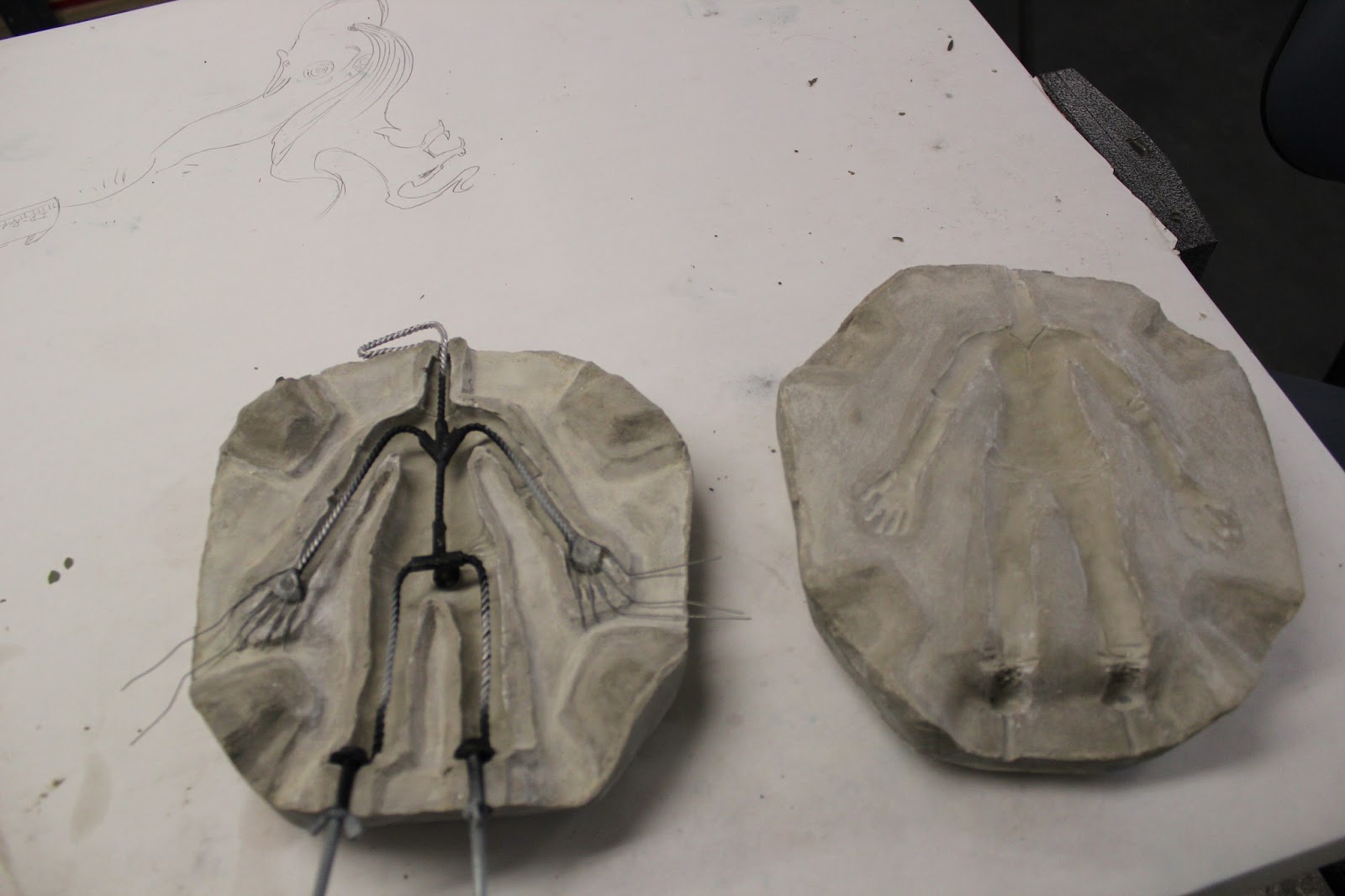
Here are the freshly welded feet, pelvis, and torso that will go inside of the puppet.


These pieces are cut down to size and braided wire is epoxied in.


 A coat of paint is put on top of the final armature to prevent the brass from eating away the foam.


 The armature is made to fit perfectly into the mold.


Mold release is applied to prevent the foam from sticking to the mold.


After whipping up the foam and baking it for 5 hours the puppet comes out of the mold with flashing.


This flashing is then trimmed down.


 Then a wood burner is used to assure that there is no extra flashing.


 Prosaid paste is used to smooth the seams and fill in an holes in the foam.

 Finally the puppet is primed and painted.


Laundry starch is used to set the paint and cut the shine factor.


Meanwhile the head is sculpted and a mold is made. This was the sculpt after it came out of the molde.


Finishing touches like hair, eyes, and mouth are added to make a final puppet. This head is a 3D print from the new 3D scanner our school has blow up a little larger. Curio is the first film on our campus to use the 3D printer and scanner. 


Saturday, April 27, 2013

Mold Making

Here is my process for making the mold for my puppet.

First I take the sculpt and bury it halfway in water based clay. It is sprayed with a coat of crystal clear.


 Next I begin building up layers of ultracal on top of the sculpt and clay.


 Wait five minutes and add another layer.


 And another.


Burlap soaked in ultracal is added in the next layer to protect the mold from breaking.


 Finally a super layer of ultracal is added and a few hours are given to let it set up.


 Then work on the second half of the mold starts. The water base clay is removed and then cleaned off. The edges of the first half of the mold are filed to remove the sharpness.

 Channels for a tight seam and being able to pry the mold apart are made out of water base clay.


 A coat of vasoline is put on any part of the first half of the mold exposed and crystal clear is put on top.


Then the whole building up process of ultracal happens again.


 Until finally the mold is set up and pulled apart.


 The original pattern usually does not survive this process.


 The last step is to clean up the mold, rinsing out the water based clay, pattern, and vasoline.